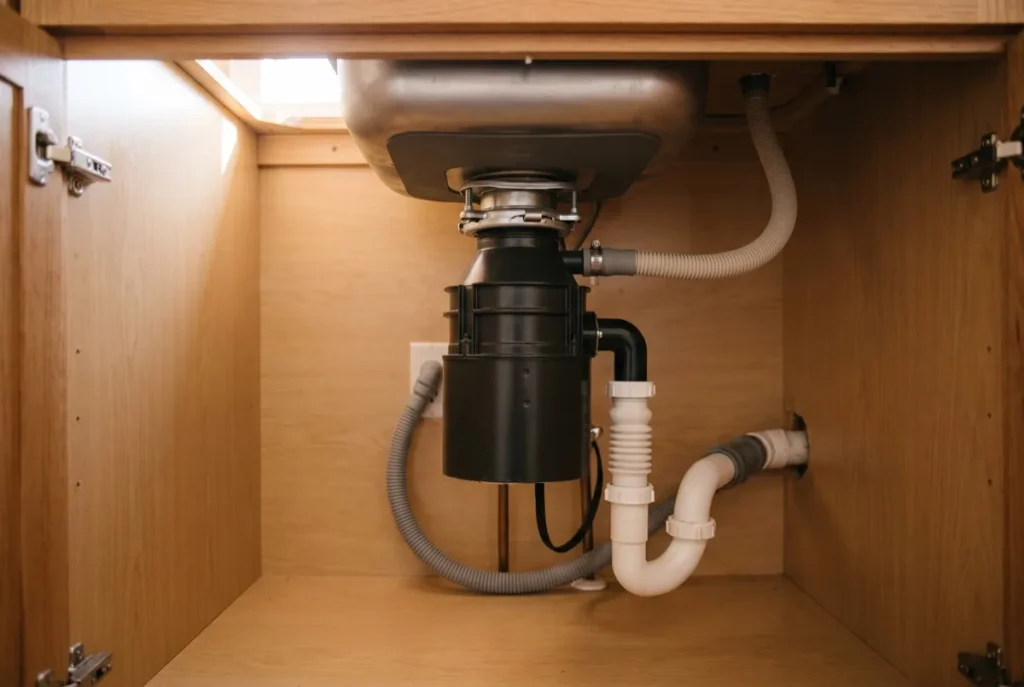
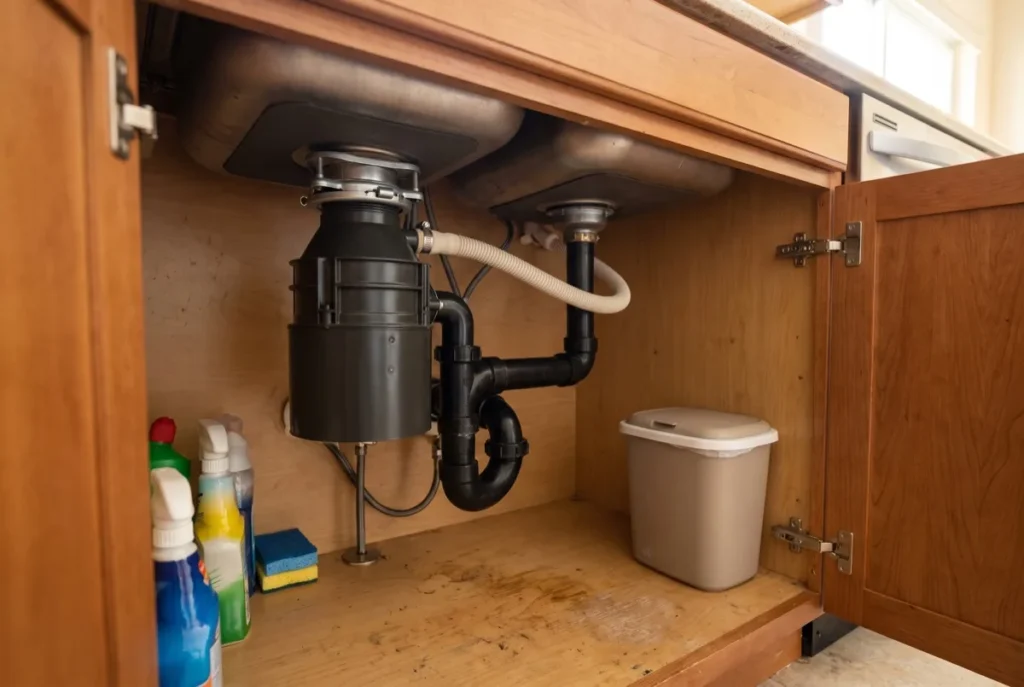
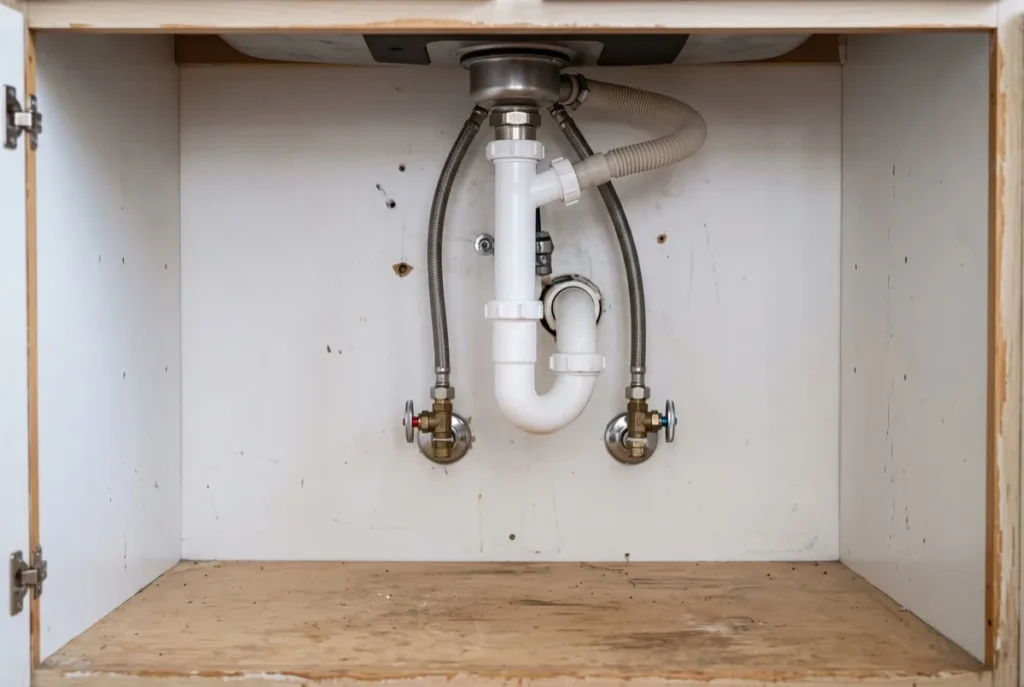
First question: is it the disposal, or is it what the disposal drains into?
The unit under your sink shares a cabinet, a drain, and a switch with other things that fail in ways that look identical from where you are standing. Read the line that sounds like your kitchen and go where it points. If two of them sound like your kitchen, say both on the form and we will sort it on the callback.
If the unit itself is the thing that hums, jams, stalls, drips, rattles, or refuses to wake up, you are in the right place and garbage disposal repair is the right page. Keep reading.
Two things worth trying before you need garbage disposal repair at all
We would rather tell you this than have you pay somebody to do it in front of you. Most units have two built-in ways out of the two most common failures, and both are on the machine itself.
Before you try either one, kill the power at the wall switch. Nothing in this section involves reaching into the chamber with your hand, and nothing in it should be done with the unit live. If you want to get something out of the chamber, use tongs, with the power off.
The first is the reset. Nearly every disposal has a small button on the underside of the housing, usually red, that pops out when the motor overloads and shuts the unit down on purpose. Push it back in. If the disposal wakes up, the motor protected itself from something and you are done for now.
The second is the manual turn. Most units ship with a small hex wrench that fits a socket in the center of the bottom of the housing, and turning it back and forth frees a motor that is stuck rather than dead. If you cannot find the wrench that came with it, the socket is a standard size and a hardware store has one.
Here is what the result tells you, which is the part the tutorials leave out:
– The reset holds and the unit works: nothing is broken today. You do not need us. – The reset works, and then the same button pops again within a day or two: the motor is overloading repeatedly, and that is a symptom rather than an accident. – The reset does nothing at all and there is no sound: the problem is on the power side. – The wrench turns freely and the unit still only hums: whatever is stopping it is not a jam you can reach. – The wrench will not budge: the unit is seized.
Any of the last four is worth describing on the form, and describing which of them you have is the single thing that makes the callback fast.
What we check before anyone gets your job
Anybody can print “licensed and insured” on the side of a van, and standing in your kitchen you have no way to tell. Florida keeps the real answer in public. The Department of Business and Professional Regulation runs a license database that anyone can search.
So we look. We pull the record the state publishes for that one professional, we read it as it stands, and we do it before your job leaves our hands, never after. The lookup is the step that comes first.
The method is deliberately narrow, and it is worth being clear about what it is not. We do not grade the professional. We do not speak for a trade as a whole, and we do not tell you what any trade is or is not required to hold. We tell you what the record says, and we do not tell you a record exists when it does not.
You can run the same search yourself. That is what a public record is for. We run it every time so that it is already done by the time you are talking to someone.
It hums but nothing turns
This is the one people search for, and it is the one where the machine is telling you the most. A hum means the motor has power and is trying. Something is stopping it.
Usually that something is small and hard: a bit of bone, a fruit pit, a bottle cap, a teaspoon that went in with the rinse water. Sometimes it is nothing you can see, and the motor itself has seized after years of short, wet, heavy cycles. From the switch, those two feel exactly the same, and the way you separate them is the wrench in the bottom of the housing described above. Free and still humming is one problem. Stuck solid is another.
A humming unit is drawing current and going nowhere, so leave the switch off until someone has looked at it. Running it in short bursts to see if it clears is how a repairable jam turns into a motor that needs garbage disposal repair it did not need an hour earlier.
On the form, say whether it hums or is silent, whether the wrench turned, and what you think went down the drain. Guessing is fine. “Something metal, maybe a spoon” is a useful sentence.
Nothing at all: no hum, no sound, no light
Silence is a different conversation from a hum, because silence means the motor is not getting power or is not answering at all. There are only a few places that can go wrong, and they are not equally likely.
Start with the reset button from the section above, because a tripped overload is silent and looks exactly like a dead machine. If that does nothing, the question is how far the silence spreads. If the disposal is the only thing out on that circuit, the problem is almost certainly at the unit or its switch, and that is the work this page is for. The outlet under the cabinet is the exception on that short list: an outlet is a wiring question rather than an appliance one, and it belongs with the electrician rather than with this page.
If the breaker trips when you flip the switch, or if other outlets and lights on the same circuit are out with it, you have a circuit question rather than an appliance question, and an electrician is the right trade for that one.
It leaks, and where it leaks matters more than how much
A wet cabinet floor tells you almost nothing on its own, because water runs before it drips. Where the water starts is what decides how big this is, and there are three answers.
From the top, where the unit meets the sink. The flange and its seal sit between the disposal and the sink basin, and when that seal gives up, water shows up every time the sink is used and stops when it is not.
From the side, where two hoses land on most units: the dishwasher line and the elbow that carries waste out. Both are connections rather than the machine itself.
From the bottom of the housing. This is the one that changes the conversation. When water comes out of the body of the unit rather than out of a connection on it, the seal inside has failed, and that is usually the end of that particular machine rather than a repair.
If the water is not coming from the disposal at all, and instead the trouble is the trap, the supply lines, or the sink fixture, that is the plumber page rather than this one. And if water is appearing somewhere with nothing installed above it, that is a hidden leak and leak detection is where that belongs.
Put a dry paper towel under the unit, run the sink for a few seconds, and tell us which part of the towel got wet. That one sentence saves the callback five questions.
Grinding metal, rattling, and the smell that will not leave
A disposal is supposed to be loud in one particular way. When the noise changes character, it is usually reporting one of two things: something in the chamber that does not belong there, or a part of the machine that has come loose or worn through. Either is worth describing rather than living with, because the cheap version of that repair happens before the expensive version.
Smell is a different animal, and it is worth being honest about it: most of the time it is not a broken machine. It is residue in the chamber and under the splash guard, and it responds to cold water, a full run, and cleaning the underside of the rubber guard that almost nobody thinks to clean.
The exception is worth knowing. If the smell comes with water standing in the sink or with a drain that empties slowly, the smell is downstream of the appliance and drain cleaning is the page for that. And if the smell arrives with more than one slow drain in the house, that is the main line, and sewer line repair is where it goes.
Repair the unit, or replace it?
You will want an answer to this before anyone comes out, and we are not going to give you one: we would be guessing about a machine we have not seen.
What we can tell you is what the question turns on, so that the conversation you have with the professional is not the first time you hear any of it. It turns on where the failure is: a jam, a switch, an outlet, a flange, or a hose is a repair by anyone’s definition, and the one exception is the failure from the bottom of the housing, described in the leak section above. It also turns on whether the motor still answers, and on how much of the work is the machine and how much is the plumbing around it.
Nobody at CheckedCrew sells you a unit, quotes you a number, or gets paid more if the answer comes back “replace”. Garbage disposal repair and replacing the unit are the same callback to us. What we do is make sure the person telling you which one you have has a state license record that was read first.
Free for homeowners
You do not pay CheckedCrew. Not to fill out the form, not for the callback, not for the match. What the work itself costs is settled between you and the professional who does it. We do not set that price, we do not quote it, and we do not take a cut of your invoice.
Where we work
CheckedCrew serves Orlando, Florida. If your property sits outside the city, put the ZIP code in the form anyway and we will tell you straight on the callback whether we can help.
What Orlando homeowners ask about a disposal that stopped