Sewer line repair, or one drain on its own? Count how many fixtures are involved
One slow drain is a drain. Several at once is usually the line they all empty into.
That single question separates the two jobs more reliably than anything you can check without equipment. If one fixture is slow and the rest of the house is normal, the problem lives in that fixture’s own branch. If fixtures that share nothing but the drain they all empty into start failing together, they are telling you they share a problem, and the thing they share is the sewer line. Waste coming back up instead of going down belongs to the line for the same reason. The particular patterns, indoors and out in the yard, are laid out further down this page.
Read the line below that sounds like your house. If you are not sure which one you are in, say what you actually observed on the form and let the callback sort it. Guessing wrong in either direction costs you a visit.
What we check before anyone is handed your job
Anybody can print “licensed and insured” on the side of a van, and standing in your driveway you have no way to tell. Florida keeps the real answer in public. The Department of Business and Professional Regulation runs a license database that anyone can search, and it is where we go to read the record the state publishes for the one professional who would be taking your job.
We read that record as it stands, and we read it before the job leaves our hands, never after. The lookup is the step that comes first. Nobody is given your job until it is done.
The method is deliberately narrow, and it is worth being clear about what it is not. We do not grade the plumber. We do not speak for the trade as a whole. We do not treat four different trades as one thing. We tell you what the record says, and we do not tell you a record exists when it does not.
On this particular job it matters more than usual, and for an uncomfortable reason: sewer work is work you cannot inspect afterward. Once the trench is closed, you are taking somebody’s word for what happened inside it. Reading a license record first is not the whole answer to that problem, and we are not going to pretend it is. It is the part of the answer that can be finished before anyone is standing in your yard with a shovel. The rest of the answer is in the two sections below, and it is about what you ask to see.
You can run the same search yourself. That is what a public record is for.
What a sewer line problem looks like from inside the house
Most people meet this problem twice. The first time it looks like bad luck, it gets cleared, and life goes on. The second time is when the pattern becomes visible.
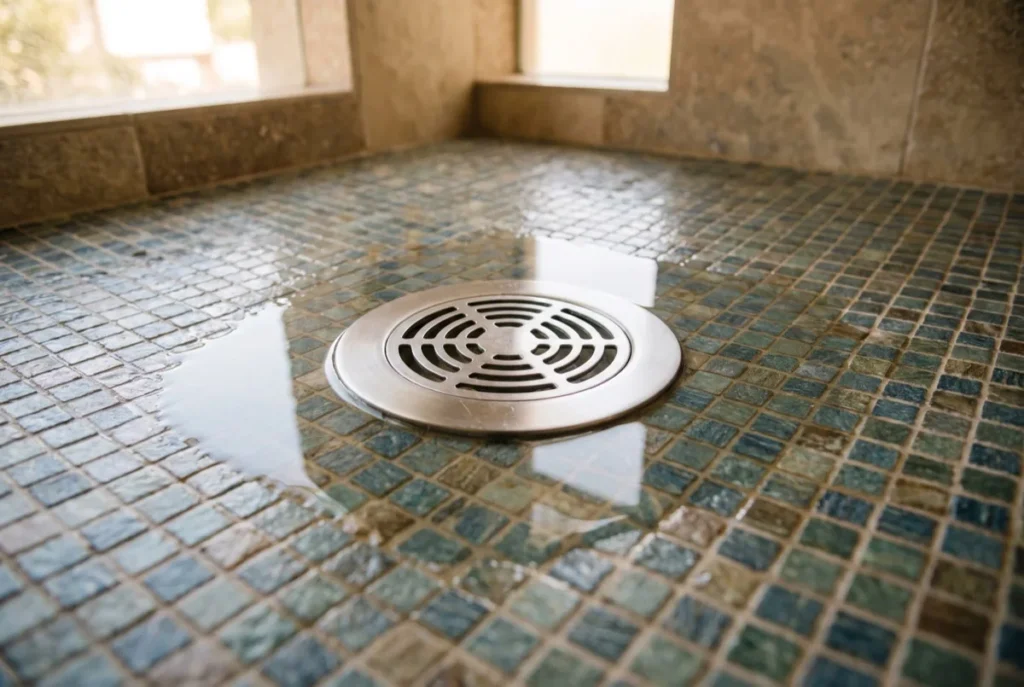
Inside, it shows up low and it shows up in groups. The fixture closest to the floor is the one that overflows first, which is why a shower pan or a floor drain is often the messenger rather than the toilet. Air has to go somewhere when water cannot, so you get a gurgle in one fixture when you drain another. Flush, and the tub answers. Run the washing machine, and the toilet in the hall bubbles. None of that is a coincidence, and none of it is something a plunger is going to settle.
Outside, it shows up as ground. A smell near the yard on a still day. A patch that stays soft after everyone else’s lawn has dried. A strip of grass greener than what surrounds it, running roughly from the house toward the street. That last one is the sign people notice last and it is often the clearest, because water leaving a waste line feeds the grass directly above it.
One caution, because it cuts both ways. A wet patch is not always waste. A supply line under the yard or under the slab makes a wet patch too, and it does it with clean water and without a single one of the indoor symptoms above. If nothing is backing up and the water is clean, that is leak detection, and it is worth ruling out before anybody digs looking for a sewer.
Nobody can tell you what sewer line repair costs without looking inside the pipe
Sewer work has the reputation it has for one structural reason: you cannot see the product. You can see a new faucet. You cannot see the pipe under your driveway, and you certainly cannot see it after the hole is filled in. Everything below is about closing that gap before you agree to anything, and it is the same thing we would want a member of our own family to do.
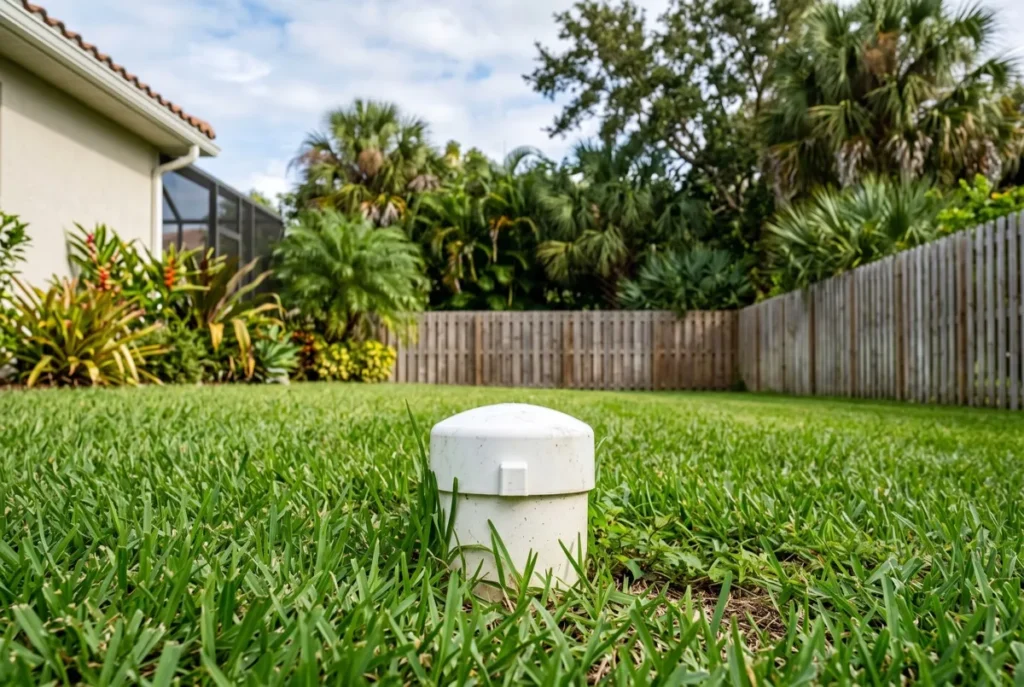
The line gets looked at with a camera on a push rod, fed in through a cleanout, which is the capped access point that lets a technician reach the line without coming through a fixture. If the house has no accessible cleanout, finding or making one is part of the conversation and you should hear about it before it happens, not on the invoice.
Watch what the camera is actually telling you, because it is three separate things:
– What the pipe is made of. Not what the neighborhood probably has. What yours is. – What is wrong with it. A root mass, a crack, a separated joint, a section that has dropped and holds water, a crushed length, or simply a line packed solid with what should have gone to the street. – Where it is. The reel is marked, so the distance from the cleanout is a measurement, not an estimate. A locator on the surface turns that distance into a spot in the yard, which is the difference between one hole in a specific place and a trench across your lawn.
Ask to stand there while the screen is on. It is your pipe, and there is no technical reason you cannot watch. Ask what the footage shows at the exact point where somebody wants to dig. Ask for a copy of the recording, and notice how the request is received.
If no camera has been in the line, nobody knows what the repair is. A number written before that point is a guess with a number attached to it.
What to ask before you agree to dig
A sewer line repair is one of the few home jobs where the questions matter more than the answers, because the questions are what tell you who you are dealing with. Somebody who does this work every week can answer all of these standing in your yard, without notes and without irritation. Somebody who cannot is telling you something worth hearing.
– Where exactly is the problem, in feet from the cleanout, and can you show me that on the screen? – What is the pipe made of, and is the whole run the same material or does it change? – Is the damage in one place, or does it repeat along the length of the line? – Which repair are you proposing, and what did you see that ruled out the other two? – What has to come up to reach it? Driveway, walk, patio, irrigation, a tree? – Does this need a permit or an inspection, and who pulls it? – Where does my responsibility end? Show me on the camera where the problem sits relative to the property line. – What will the line look like on camera when you are finished, and will you run it again so I can see?
You will hear three words in the answers, and they are worth knowing before somebody uses them on you. A spot repair opens the ground at one location and replaces a short section. Lining rehabilitates the existing pipe from the inside, without a trench along the whole run. A replacement puts in a new line for some or all of the length. We are describing the vocabulary, not recommending one of them. Which is right is a call made after the camera, by the person who looked, about your specific line.
The question about where your responsibility ends is the one people forget to ask, and it is not a question to settle from a desk or from a page like this one. Ask it in the yard, with the camera running, and ask to be shown on the screen.
Roots, old pipe, and a yard that has been there a while
Two things do most of the damage to a residential sewer line, and neither of them is anything you did.
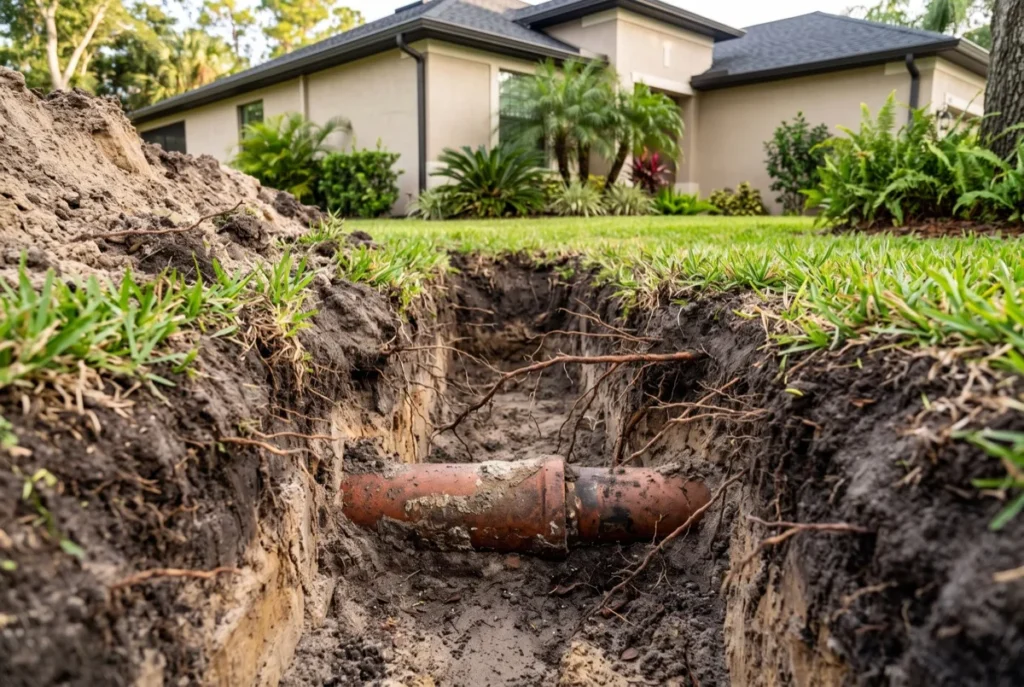
The first is roots. A sewer line is a warm, damp, nutrient-rich channel running through soil, and a root that finds a joint or a hairline crack will grow toward it and then into it. It rarely announces itself. It starts as a drain that clears when someone runs a cable through it, comes back a few months later, then comes back sooner than that. If there is a mature tree standing between your house and the street, that is the first thing worth asking the camera about.
The second is the pipe itself. Residential lines have been built out of clay, cast iron, and several generations of plastic, and they do not fail the same way or on the same schedule. This is not a thing to settle by arguing about how old the neighborhood is. The camera tells you what your line is made of, and that answer belongs to your house rather than to your street.
If a cable has already cleared this line more than once, put that on the form. A line that keeps closing is a different conversation from a line that closed for the first time last night, and the recurrence is itself the information. Repeated clearing is often the moment a drain cleaning call turns into a sewer line question, which is why we ask.
Free for homeowners
You do not pay CheckedCrew. Not to fill out the form, not for the callback, not for the match. What the sewer work itself costs is settled between you and the professional who does it, after that person has put a camera in your line. We do not set that price, we do not quote it, and we do not take a cut of your invoice.
Where we work
CheckedCrew serves Orlando, Florida. If your property sits outside the city, put the ZIP code in the form anyway and we will tell you straight on the callback whether we can help with it.
What Orlando homeowners ask before they let anyone dig