Replace it, or repair it one more time?
If you have already decided, the rest of this section is here to check that decision rather than to sell it to you. A heater that has been opened before, that has been losing ground for months, and that is old enough that nobody in the house remembers it being installed is a heater on its way out. Replacing it is a decision you make once instead of a repair you make again in the spring.
But the honest version of this page says the other half out loud. If the unit is not old, if nobody has been inside it before, and if what failed is one identifiable part, then what you have is water heater repair and it has its own page, and that is where to start instead of here. Nothing on this page is a reason to throw out a heater that has years left in it.
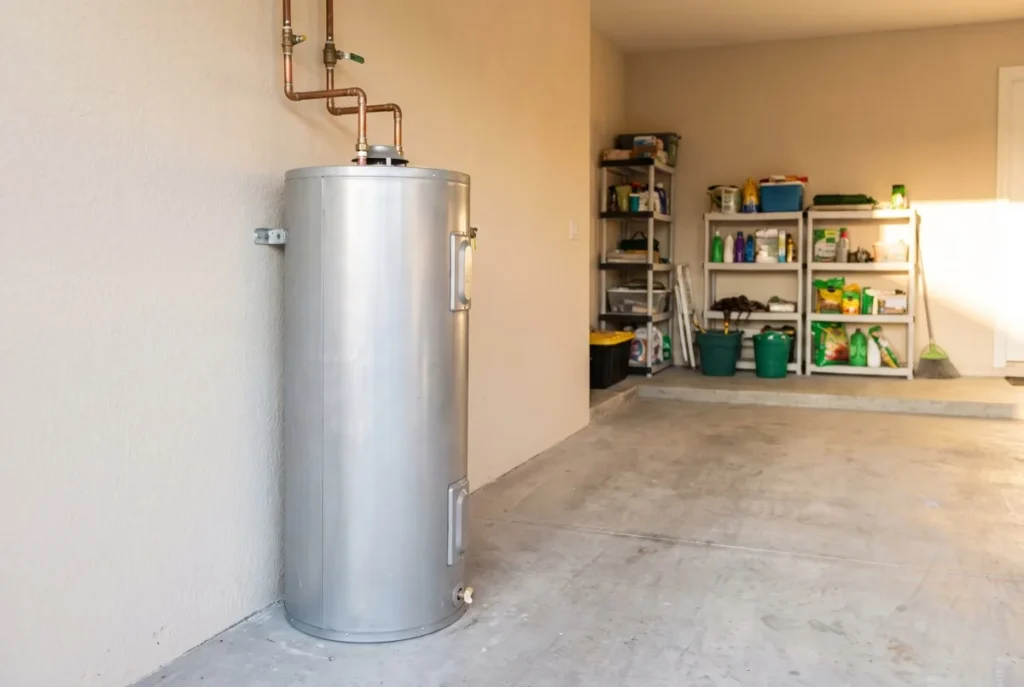
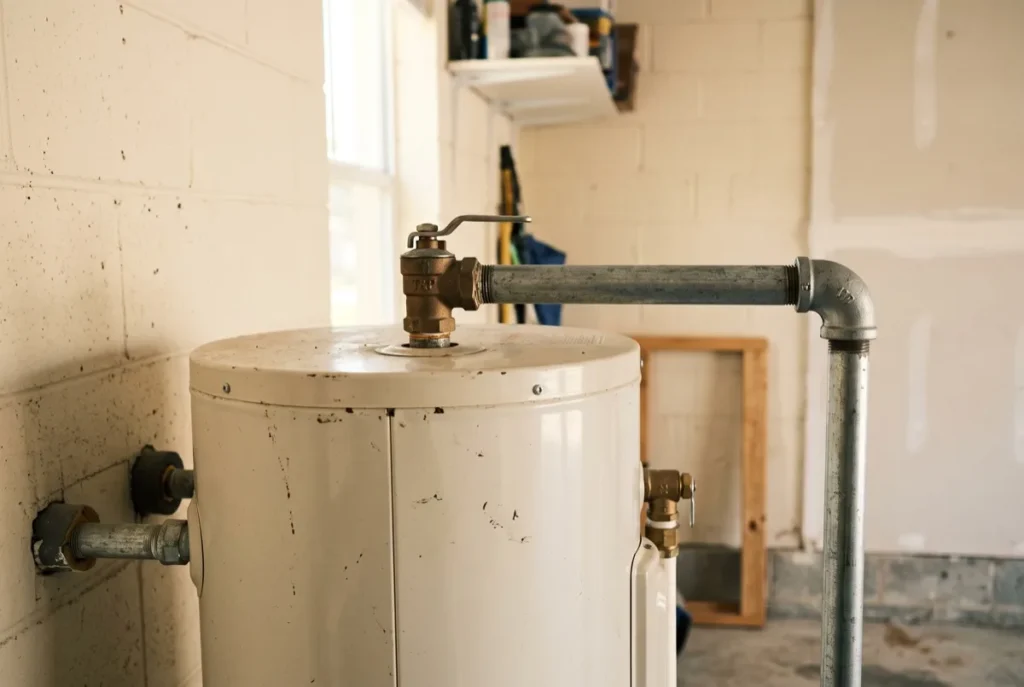
The thing that usually settles it is the tank itself. A part inside a sound tank is a repair. A tank that is weeping at a seam, rusting through at the bottom, or leaving a ring on the garage floor is not a part anyone swaps, and that is the point where a water heater replacement stops being a choice and becomes the plan.
If you are genuinely unsure which side of that line you are on, that is a fine thing to say on the form. Deciding it from a description is not something we do, and it is not something you should have to do alone.
What gets checked before anyone touches your heater
Anybody can print “licensed and insured” on the side of a van, and standing in your driveway you have no way to tell. Florida keeps the real answer in public. The Department of Business and Professional Regulation runs a license database that anyone can search, and we search it for the individual professional before your job leaves our hands, never after.
We pull the record the state publishes for that one person and we read it as it stands. The method is deliberately narrow, and it is worth being clear about what it is not. We do not grade the professional. We do not speak for a trade as a whole. We do not treat four different trades as one thing. We tell you what the record says, and we do not tell you a record exists when it does not.
You can run the same search yourself. That is what a public record is for. We run it every time so that it is already done by the time you are talking to someone about a unit that is going to sit in your house for years.
Tank or tankless
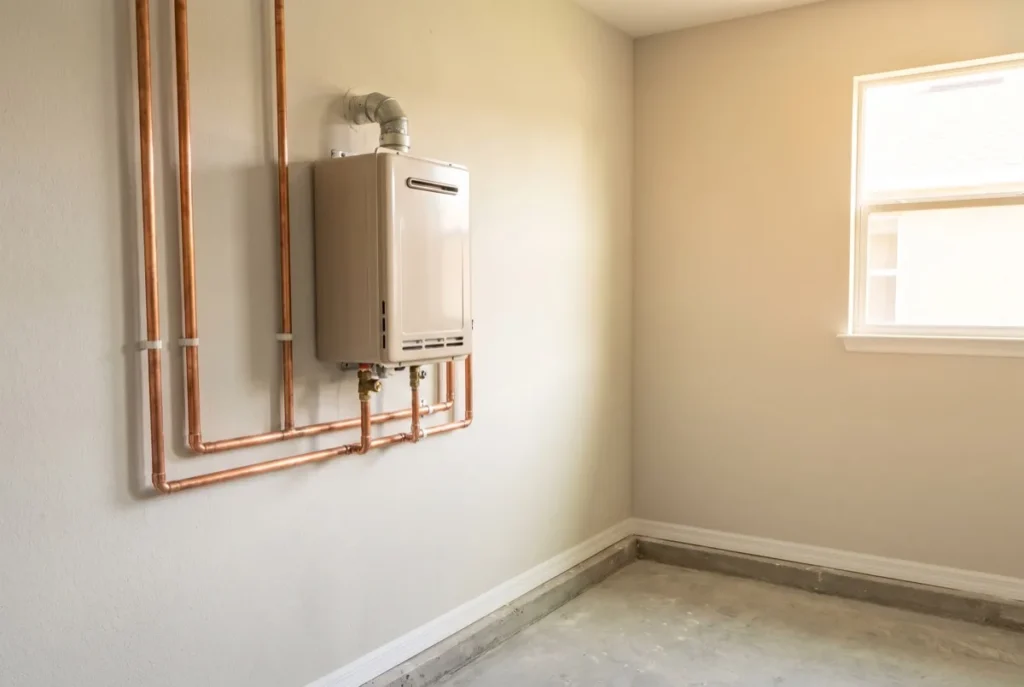
This is the first real fork, and it is the one with the least obvious answer. A tank keeps a standing supply hot and refills it after you use it, so what you get is a finite amount of hot water and then a wait. A tankless unit heats water as it moves through, so what you get is no waiting and no reserve, with a limit on how much can be hot at the same time rather than on how long it lasts.
Neither of those is the right answer in the abstract. What decides it is the house you actually have:
– Where the unit lives and what fits there. A garage wall, a closet in a hallway, an attic platform, and an outside wall are four different situations, and they do not accept the same equipment. – What the house is already plumbed and vented for. Changing the type of unit can mean changing the venting, and that is part of the work rather than a detail. – Whether your supply lines and gas or electrical service already support the unit you are imagining. Where they do not, a replacement carries that work with it, and the scope is larger than a straight swap. – How your household actually uses hot water. Two long showers back to back and two showers running at once are different problems, and they point at different equipment. – What the upkeep looks like where the unit sits. Ask the person who quotes it what the unit you are considering will need from you, and how often.
What we will not do is tell you which one is cheaper, because we do not know and because the number would be invented. The money side of this decision comes from the professional who sees your garage, your venting, and your panel. Our side of it is making sure that the person quoting it has a license record we already read.
Sizing, in the way that actually matters
Sizing sounds like a specification and behaves like a household question. The useful version of it is not what number is on the old label, it is whether the old unit was keeping up. A heater that was already running short before it failed should not be replaced with the same thing out of habit, and a heater that was keeping up until it failed does not need to be upsized just because it is being replaced.
The things worth having ready when we call:
– How many people are in the house, and whether that changed since the unit went in. – Whether you ever run out, and if so, at what point in the day it happens. – Whether more than one thing wants hot water at the same time, like a shower and the laundry, or two bathrooms in the morning. – Whether there is a large tub anyone actually fills. – Whether anything is planned that will change the answer, like a bathroom being added.
You do not need to convert any of that into a capacity. That translation is the job of the person who comes out.
Gas or electric, and what your house already has
The fastest way through this one is to start from what is already there. A replacement that keeps the same fuel is a swap. A replacement that changes fuel is a small project attached to a swap, because it brings in a gas line or an electrical circuit that does not exist yet, and often a change in venting as well.
That does not make switching wrong. Plenty of houses have a good reason to move, and the reason is usually about where the unit can sit, what the household needs, or what the rest of the house already runs on. It does mean the conversation is a different conversation, and it is worth saying on the form which one you are having, because the two need different things from whoever shows up.
If you do not know what fuel yours is, look for a flue or vent pipe leaving the top of the unit and going up. That is a reasonable clue and it is not a commitment. Getting it wrong on the form costs you nothing, and the callback is exactly where it gets sorted out.
What a water heater replacement day actually involves
A replacement day has two parts that are not the new unit at all. The first is that the old one has to leave: it gets drained, disconnected, and carried out, and in a lot of Orlando houses that means a tight garage corner, an attic platform, or a hall closet with a door narrower than the equipment.
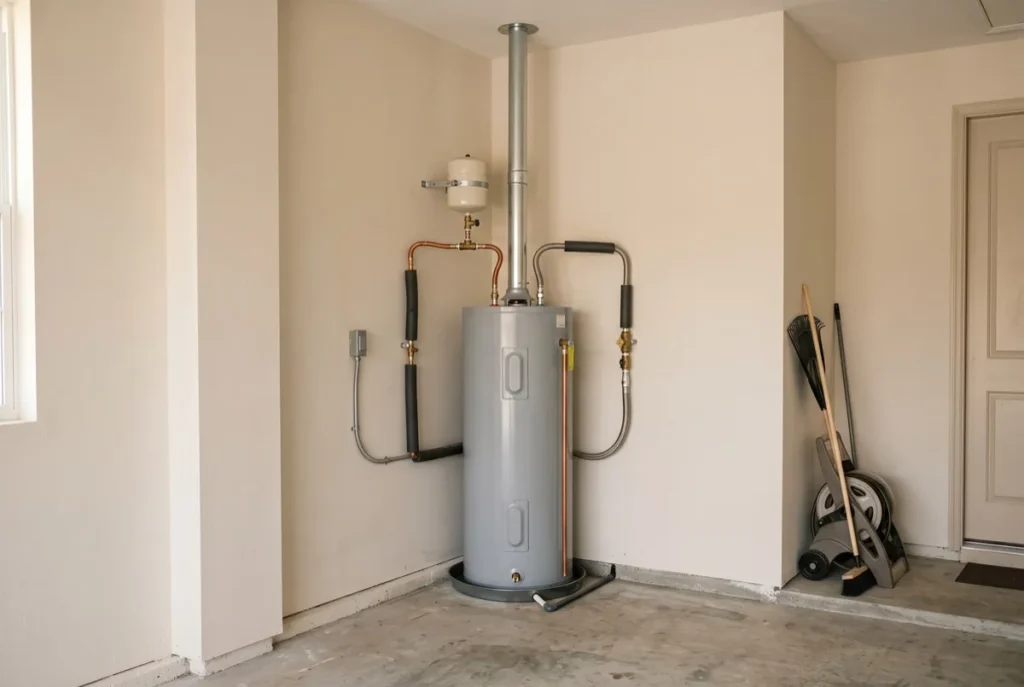
The second is that a replacement is rarely just the appliance. Connections, shutoffs, the drain pan, and the way the unit is secured and vented are all part of it, and some of that may need to be brought up to current requirements even when the old unit sat there without complaint. All of that is part of replacing the unit, not something added on top of it.
Useful things to mention on the callback: where the unit is, how you get to it, whether anything has to be moved to reach it, whether there is a drain nearby, and whether the house is occupied while the work happens. If a permit or an inspection is part of your situation, say that too, so it is known before the first visit rather than after.
Which water heater page is yours
Three different situations get described with the same three words, and they are not the same job. Read the line that matches your house and go where it points.
Two more that get confused with a failing heater:
– Water showing up where nothing is installed, or a water bill that moved without you changing anything, is not the heater, and that belongs to leak detection – If what you have is a whole list of plumbing questions rather than this one, start at the plumber page
What to say if you do not know what you have
Nobody is expected to walk into the garage with a flashlight before filling out a form. The description that works is the one you would give a neighbor.
Any of these is enough on its own:
– “It is rusty at the bottom and there is water on the floor around it.” – “We run out of hot water halfway through the second shower.” – “It was repaired last year and it is doing the same thing again.” – “It is old and I would rather replace it before it fails in the middle of the night.” – “There is a puddle and I have no idea whether it is the heater.”
The last one is a legitimate answer, not a failure to prepare. Sorting out which of those you actually have is most of what the callback exists for.
Free for homeowners
You do not pay CheckedCrew. Not to fill out the form, not for the callback, not for the match. What the replacement itself costs is settled between you and the professional who does it. We do not set that price, we do not quote it, we do not publish a range for it, and we do not take a cut of your invoice.
Where we work
CheckedCrew serves Orlando, Florida. If your property sits outside the city, put the ZIP code in the form anyway and we will tell you straight on the callback whether we can help with it.
What Orlando homeowners ask before replacing a water heater