Is it the opener, or is it the door?
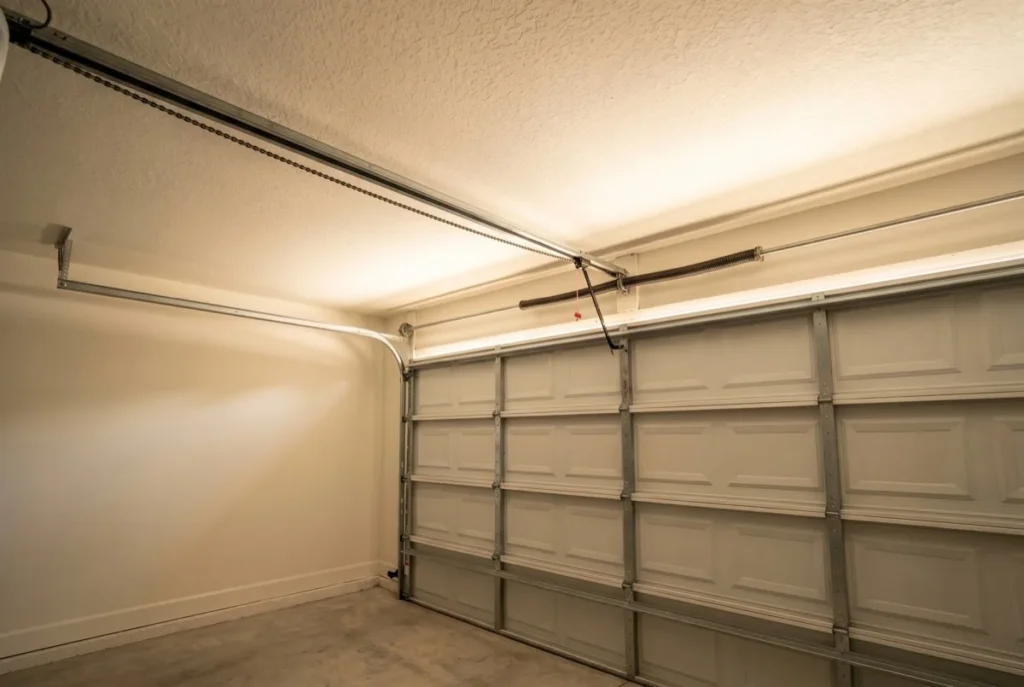
A garage door call splits early into two very different jobs. The opener is the motor on the ceiling and everything that commands it: the logic board, the safety sensors near the floor, the remotes, the keypad outside, the wall button. The door is the panels, springs, cables, rollers, and the track they run in — that side is garage door repair, not this page. One is electrical and the other is under tension, and they are not fixed by the same visit.
Here is the line to read: if the motor runs and the door does not follow, treat it as a door problem first. If nothing on the ceiling reacts at all, or the door moves but refuses to finish, start with the opener. Read the line that sounds like your garage:
If you are not sure which side of that line you are on, say what you saw and heard on the form and let the callback sort it. Everything below this point is garage door opener repair — the motor and what commands it.
What we look up before a job is handed off
Anybody can print “licensed and insured” on the side of a van, and standing in your driveway with a car trapped behind a door you have no way to tell. Florida keeps its own answer in public: the Department of Business and Professional Regulation runs licensing records that anyone can search.
So we search them. For the individual professional, by name, before the job is handed off, never after. Then we tell you what came back.
That last sentence is the whole method, and it is narrower than it sounds. We report what the state’s record says about one named person. We do not grade anybody. We do not speak for the garage door trade as a whole, and we do not tell you what that trade is or is not required to hold — that is not ours to declare. If the record has something on that person, you hear it. If the search comes back empty, you hear that too, in those words, and you decide what you want to do with it.
You can run the same search yourself. That is what a public record is for. We run it every time so that it is already done by the time anyone is standing in your driveway.
What actually fails in a garage door opener
An opener is a small motor, a drive that pushes a trolley along a rail, a logic board that decides when to run, and a handful of things that can tell it to stop. Garage door opener repair problems trace back to one of those four parts, and each one announces itself differently.
None of what follows below asks you to open the motor housing or touch the wiring at the ceiling. If a spring, cable, or drum looks wrong, or the door is behaving in a way that points to one of them, stop and use the form — that is garage door repair, not this page. What is and is not safe to check yourself is covered in full in “Before anyone drives out,” further down this page.
The motor runs and nothing moves. On a chain or belt unit, this can point to the drive gear inside the head — a plastic part that can wear down over time. You get the sound of the motor working and no travel at all, sometimes with plastic shavings on the garage floor under the head. It is also what a disconnected trolley looks like, which is a far smaller thing.
The door starts down and reverses. This is the safety system doing its job, and it points to the sensors near the floor rather than the motor. That has its own section below.
The door stops partway, in the same spot every time. Openers learn how far the door should travel and how hard it should have to push, and those settings drift. Stopping in an identical place every attempt points either to a limit setting or to something in the track binding at that point — and the second one is the door’s problem rather than the opener’s, which belongs on garage door repair.
Nothing happens at all. Openers plug into a single ceiling outlet on a circuit that can trip, and a dead opener and a tripped breaker look identical from the driveway.
Then there is noise. Where in the travel it happens says more than how loud it is, which makes it the one symptom worth describing exactly on the callback.
Garage door sensor repair
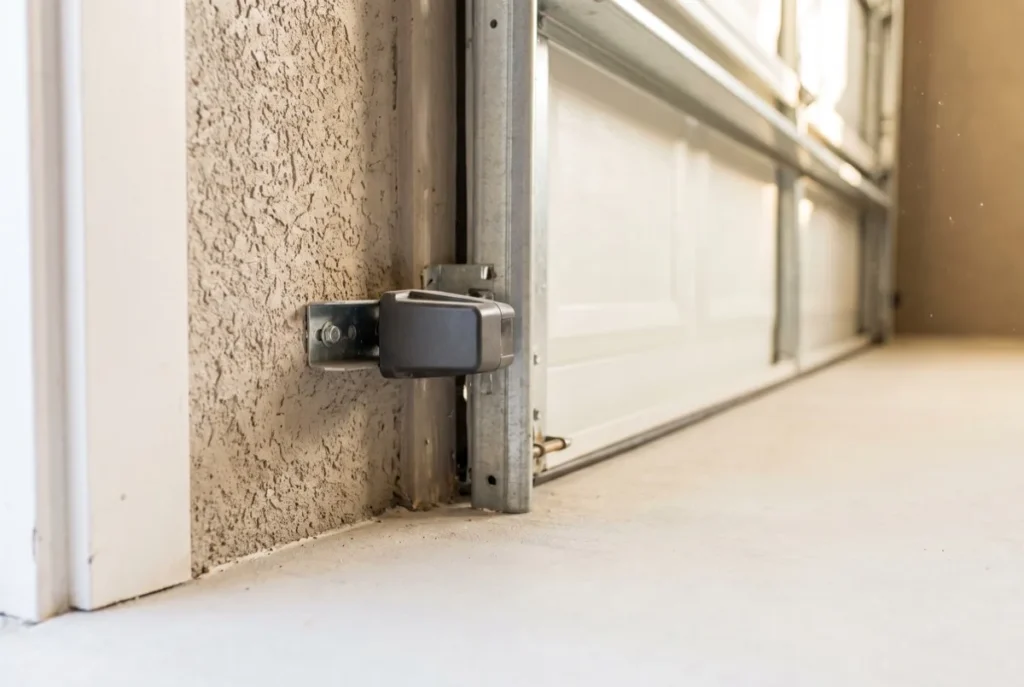
Two small eyes sit near the floor on either side of the opening, and they watch an invisible line across the door. If that line is broken while the door is closing, the opener sends the door back up. When the door reverses instead of closing, these sensors are the first thing to check — garage door sensor repair starts with alignment, not with assuming a broken part.
They come out of alignment for undramatic reasons: a bike leaning on the bracket, a bag of mulch, a vacuum hose, someone brushing past on the way to the car. The brackets move with a shoulder, and once one eye points slightly off the other, the door stops closing.
They also get dirty, and in Florida they get blinded. A film of dust on the lens is enough, and so is low afternoon sun landing straight into one of them — which is why a door that closes all morning and reverses every evening points to the sensors, not the motor.
Units have a way to show you which it is: the sensors carry small indicator lights, and the head unit overhead blinks its bulb in a repeating count when the beam is not being seen. That blink count means something specific in the manual for your unit, and it is worth counting before anyone arrives.
What is left after alignment and cleaning is real repair work: a wire pinched flat by a staple, a bracket that will not hold position, a sensor that has actually failed, or a head unit that no longer reads either of them. Say what you already tried when you fill out the form. It shortens the visit.
Garage door remote programming
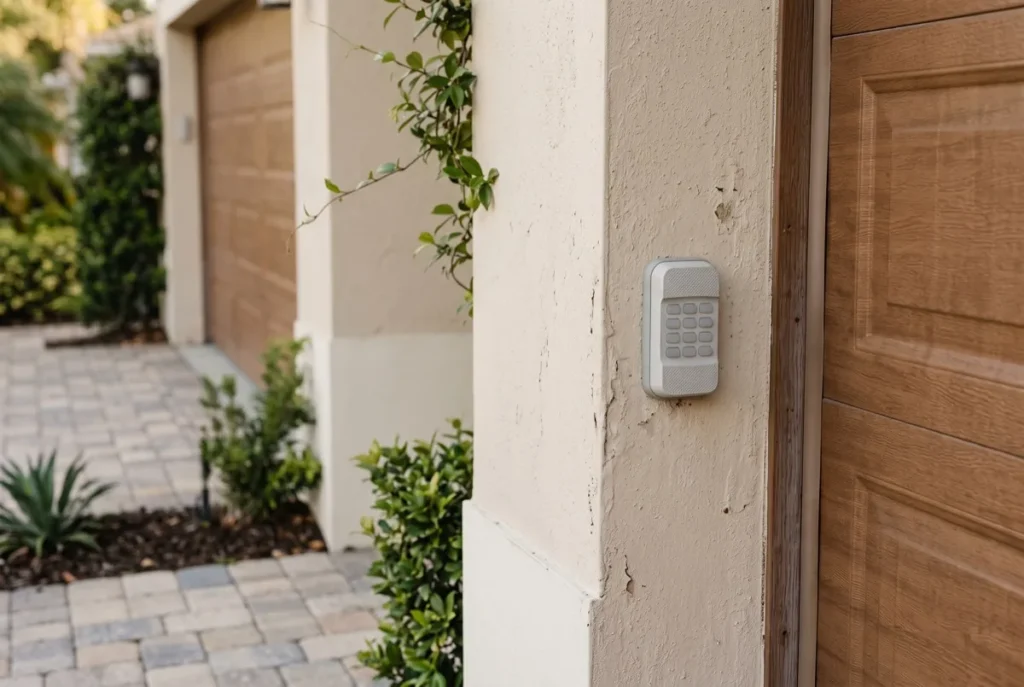
Not every opener problem is about the door itself — the door can work from the wall button and stop answering everything else: the remote in the drawer, the button in the car’s mirror, the keypad by the side door.
That split is the most useful thing you can tell us. If the wall button still opens the door, the motor and the drive are fine and the conversation is about garage door remote programming: a remote that lost its pairing, a new remote that was never paired, a keypad that needs its code set again, or a car that was paired to an opener that has since been replaced.
Some of it you can do yourself. There is a learn button on the head unit — check near the light lens — and pairing a remote is a short sequence of pressing it and then pressing the remote. The steps differ enough between brands and between generations that the manual for your unit is worth finding before you start.
Here is where it stops being simple: a learn button that does nothing, a unit old enough that no current remote will pair with it, a keypad that accepts a code and then forgets it, rolling-code security that will not accept a used remote, or a car system that will not hold the pairing. Those are opener problems, not remote problems, and they are what this page is for.
One thing worth ruling out first, because it costs nothing: wall consoles can carry a lock or vacation button that stops the opener from answering remotes at all. The section below says where to look.
When the opener is old enough that repair stops being the question
Sometimes the honest answer is that the unit on the ceiling has reached the end. An opener that has to be forced through every cycle, a head unit no remote made today will pair with, a board that fails again shortly after it was addressed — at some point garage door opener repair turns into a decision about the unit itself rather than a fix.
That call belongs to the professional who is looking at it, in your garage, with the cover off. It is not a call to make from a form and it is not one to make from a web page. What we can say is that it stays inside the same conversation: the motor and what commands it are this page either way, and you start it the same way, with the form.
A different door is a different subject — if the panels are what you are unhappy with, that is garage door installation, and it is worth deciding that before anyone looks at the motor.
Before anyone drives out: what you can check yourself
This is one of the few home repairs with fixes that cost nothing, and we would rather tell you than sell you a visit you did not need.
Start here, before anything else: do not pull the manual release cord on a door you suspect has a broken spring, and do not try to lift that door by hand to find out; a garage door is counterbalanced by springs under serious tension, and when one of them lets go the door is no longer held by anything; springs, cables, drums, and the bottom brackets are not homeowner work, and that is garage door repair rather than this page. The same goes for opening the head unit itself or working on the wiring at the ceiling. If anything here gives you doubt, stop and use the form.
With that clear, four things are worth trying, and none of them need a tool.
Check the wall console for a lock or vacation button, and check the outlet the opener is plugged into, along with the breaker for it.
Wipe both sensor lenses with a dry cloth, both eyes. Then look at the indicator lights on them and see whether both are steady.
Look at the sensor brackets. If one eye is pointed even slightly away from the other, ease it back by hand until the lights hold steady. They are meant to be adjustable.
Change the remote battery, then test the wall button. If the wall button opens the door and the remote still does not, you have narrowed the problem to the remote, which is the best news on this page.
If none of the four fixed it, that is a real call. The form is at the top and the bottom of this page.
Free for homeowners
You do not pay CheckedCrew. Not to fill out the form, not for the callback, not for the match. What the repair itself costs is settled between you and the professional who does it. We do not set that price, we do not quote it, and we do not take a cut of your invoice.
Where we work
CheckedCrew serves Orlando, Florida. If your property sits outside the city, put the ZIP code in the form anyway and we will tell you straight on the callback whether we can help with it.
What Orlando homeowners ask about a garage door opener